
Strategic Guide to Facility Management Companies in Egypt: Optimizing Corporate Assets
Strategic Guide to Facility Management Companies in Egypt: Optimizing Corporate Assets
The scale of modern commercial architecture requires far more than basic custodial care.
In Egypt’s expanding corporate landscape anchored by massive hubs like the New Administrative Capital, New Cairo, and the 6th of October City the management of physical environments has become a core business strategy. Enterprise-level infrastructure demands exact technical oversight to maintain operational continuity, manage escalating energy costs, and preserve structural valuations over multi-decade lifecycles.
Choosing between disjointed vendors and professional corporate asset caretakers is a critical operational decision. As companies navigate complex economic shifts and volatile real estate valuations, partnering with specialized facility management companies in Egypt offers a clear competitive edge. At HSS-FM, we transform building upkeep from an unpredictable cost center into a predictable, value-driven process that directly strengthens structural efficiency.
The Evolving Facility Management Companies in Egypt
The Egyptian building management sector has experienced an unprecedented structural shift. Historically, corporate property maintenance in Egypt relied heavily on fragmented, reactive local vendors or informal, in-house staff. This traditional method often resulted in deferred maintenance, unexpected equipment failures, and premature asset depreciation.
Today, rapid urbanization and massive commercial development projects are driving a clear market transformation. Multinational entities, premium medical facilities, institutional complexes, and industrial plants now require unified operational frameworks. Specialized building management solutions are replacing old, piecemeal models to protect capital expenditures, ensure regulatory compliance, and meet international health, safety, and environmental standards.
Instead of the outdated approach where fixing things only happens when they break, HSS-FM utilizes automated systems to transition your operations directly from reactive repairs to predictive and scheduled care. This shift helps eliminate multiple fragmented vendors, substituting them with a single integrated provider that relies on IoT and CAFM software data rather than manual logs. Consequently, businesses avoid unpredictable cost spikes and secure a structured, fixed operational expenditure.
Core Operational Models: Hard vs. Soft FM Services
Professional providers divide their operational workflows into two main categories: hard and soft services. Achieving high efficiency requires combining these two pillars into a single, cohesive management strategy rather than managing them as isolated tasks.
Hard FM Services
Hard services cover the complex technical infrastructure embedded within a building’s fabric. These components require specialized engineering skills, strict regulatory compliance, and rigid preventative maintenance schedules to prevent costly downtime.
-
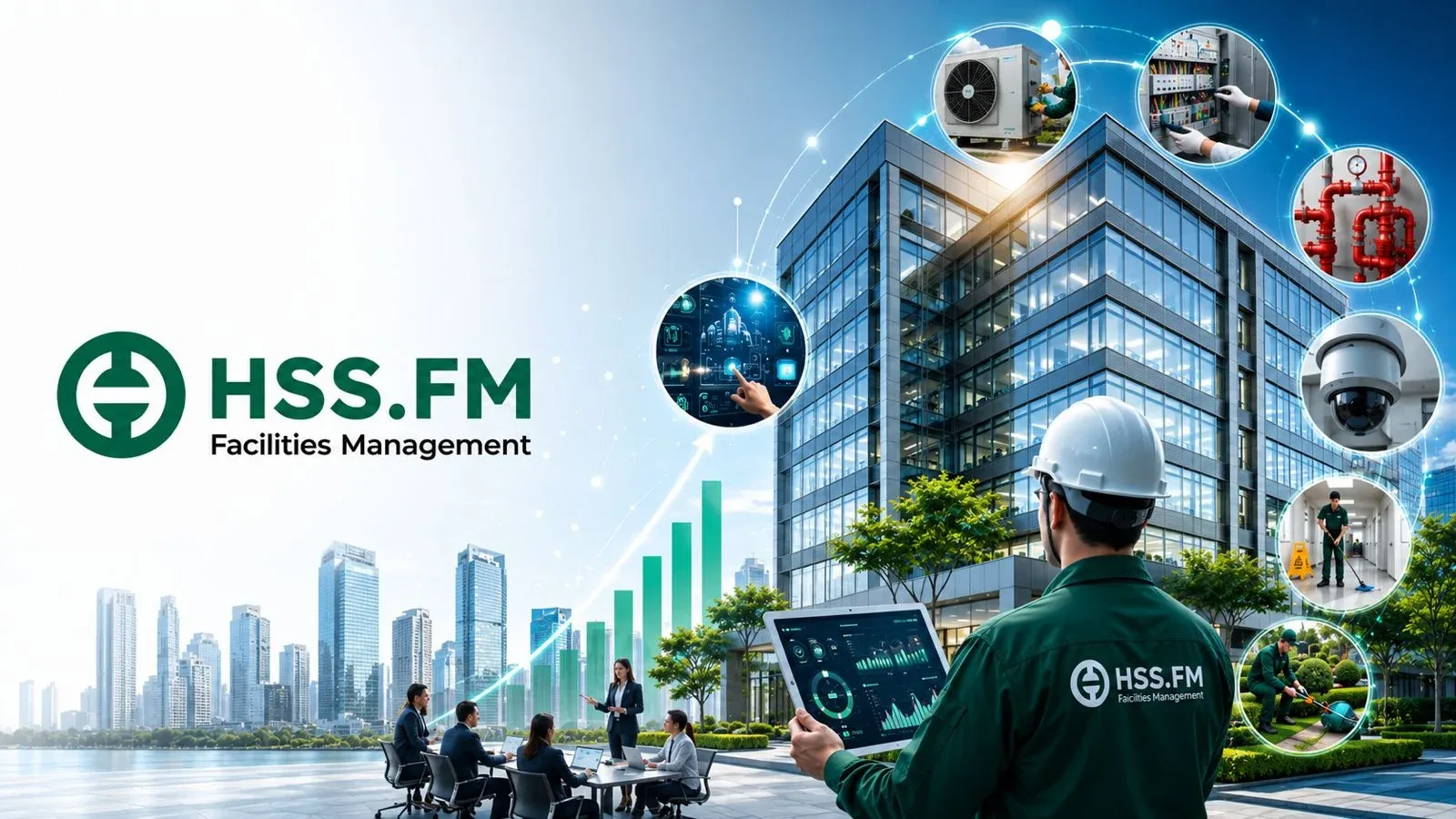
HVAC Systems and Chiller Plants: Monitoring, balancing, and cleaning industrial climate control units to protect indoor air quality and lower energy usage.
-
Electrical Distribution Networks: Regular infrared thermography, load testing, transformer maintenance, and low-voltage system calibration.
-
Plumbing, Drainage, and Water Treatment: Managing greywater systems, industrial pumping stations, booster pumps, and complex plumbing networks.
-
Fire Life Safety and Automation: Managing building management systems (BMS), maintaining smoke detectors, and checking automated fire suppression systems to meet Civil Defense standards.
Soft FM Services
Soft services shape the everyday user experience, ensuring the corporate environment remains safe, healthy, and highly productive for employee operations.
-
Corporate Janitorial and Deep Cleaning: Scheduled disinfection, facade cleaning for high-rise buildings, and strict waste stream separation.
-
Physical Security and Access Management: Trained security guards, gate management, and operating closed-circuit television (CCTV) surveillance networks.
-
Pest Control and Hygiene Management: Applying safe, certified chemical treatments designed to control pest disruptions without affecting workplace safety.
-
Grounds Upkeep and Corporate Landscaping: Managing interior plant scapes and external corporate green spaces using water-efficient irrigation methods.
Market Dynamics: What is Driving Facility Management Companies in Egypt?
Corporate leaders are increasingly choosing facilities management outsourcing over maintaining large, costly internal operations teams. This shift is driven by regional expansion, the rise of massive urban megaprojects, technical advancements, and a focus on core corporate strengths.
1. Cost Predictability Amid Currency Fluctuations
Volatile currency adjustments put pressure on operational budgets. Managing supply chains for replacement parts in-house can lead to unpredictable price hikes. Professional providers like HSS-FM leverage volume purchasing agreements with global component manufacturers to deliver fixed, predictable operational expenditures.
2. Implementation of Smart Building Technology
Modern corporate offices utilize intricate, tech-driven systems. Elite providers deploy Computer-Aided Facility Management (CAFM) platforms alongside IoT sensors to track equipment health in real time. This technical framework shifts building maintenance from reactive repairs to data-driven predictive adjustments, minimizing unexpected outages.
3. Strict Compliance and Workforce Optimization
Egyptian labor laws place significant administrative and regulatory duties on corporate employers. Outsourcing workforce management shifts compliance risks, specialized safety certifications, insurance liabilities, and continuous technical training to an external partner, allowing companies to focus fully on their core operations.
Industry-Specific Demand Across Key Egyptian Sectors
Different industrial landscapes require highly specialized care frameworks. A standard, generic approach cannot satisfy the unique demands of distinct commercial properties.
Commercial Facility Management
Premium office spaces and corporate headquarters in business districts focus heavily on uptime and tenant experience. Providers prioritize uninterrupted electrical systems, seamless connectivity, spotless janitorial standards, and efficient climate control to retain premium tenants and protect the property’s market value.
Industrial Facility Services
Manufacturing plants and distribution centers in areas like 10th of Ramadan City require specialized technical support. Maintenance companies in Egypt operating in these zones focus on heavy machinery power systems, keeping high-pressure compressed air systems running smoothly, and maintaining industrial floors to avoid production delays.
Retail and Lifestyle Centers
Large retail centers require scalable soft services that adapt to fluctuating visitor traffic. Providers coordinate round-the-clock janitorial teams, high-capacity waste handling, and comprehensive security frameworks to manage large crowds during peak shopping periods.
Evaluating Providers: Why HSS-FM Stands Out
Selecting from the various Facility Management Companies in Egypt requires looking beyond baseline cost metrics. Corporate leaders should run thorough vendor evaluations using a structured, quality-first framework.
-
Documented Engineering Experience: HSS-FM offers a proven track record and detailed historical performance data on properties that match your specific building layout and technical scale.
-
International Quality Standards: Look for companies that hold verified certifications, including ISO 9001 (Quality Management), ISO 14001 (Environmental Management), and ISO 45001 (Occupational Health and Safety).
-
Technology Deployment: We integrate advanced CAFM platforms rather than relying on manual spreadsheets to track open maintenance requests and equipment histories.
-
Supply Chain Resilience: HSS-FM maintains an active inventory of long-lead mechanical parts to bypass localized shipping delays and ensure fast turnaround times.
The Financial Return of Integrated Facility Management Services
Investing in integrated facility management services delivers clear, measurable financial returns over the lifecycle of a property. Rather than viewing maintenance as an immediate cash drain, forward-thinking CFOs analyze how proactive upkeep directly improves structural asset valuations.
When analyzing the traditional in-house maintenance approach against an integrated outsourced strategy, the financial differences become obvious. A reactive approach typically reduces the lifespan of complex mechanical systems to just eight or eleven years. In contrast, the predictive care provided by HSS-FM extends asset functionality to fifteen or twenty years.
Furthermore, utility expenses show a massive difference. While unmonitored in-house systems continuously drain power, automated building management systems generate an eighteen to twenty-five percent reduction in energy consumption. This transformation eliminates high-cost emergency outages and shifts high internal labor overhead into a flexible, highly scalable contracted service model. By extending equipment lifecycles and significantly reducing energy usage, corporate entities can lower long-term capital replacement costs while lowering day-to-day building operation expenses.
FAQ Section
What is the core difference between hard and soft facility services?
Hard services cover fixed, structural physical elements that require direct engineering intervention, such as primary power transformers, industrial HVAC chillers, and automated plumbing systems. Soft services focus on daily environment management, including office janitorial work, physical corporate security, exterior landscaping, and indoor pest control.
How do facility management companies in Egypt calculate contract pricing?
Facility Management Companies in Egypt Contract pricing depends on total structural square footage, the age and technical complexity of onsite machinery, required staff counts, and the agreed-upon Service Level Agreements (SLAs). HSS-FM provides consolidated monthly billing options that cover scheduled preventative labor, emergency response access, and routine consumables.
Why is an integrated approach better than hiring separate Facility Management Companies in Egypt ?
Hiring separate vendors often creates communication gaps, finger-pointing during unexpected system failures, and administrative bloat from managing multiple invoices. An integrated framework with HSS-FM puts all structural responsibilities under one point of contact, ensuring clear accountability and lower administrative costs.
Can outsourcing facility management help lower corporate energy costs?
Yes. Professional providers utilize real-time building management systems to track utility usage patterns. By adjusting HVAC cycles to match actual occupancy, repairing compressed air leaks, and maintaining electrical balances, HSS-FM can cut baseline energy costs by 15% to 30%.
What certifications should I look for when vetting building management solutions?
Look for providers with verified international standard certifications. Key indicators of professional corporate competence include ISO 9001 for quality assurance, ISO 14001 for sustainable environmental practices, and ISO 45001 for strict workplace safety management.
And For MEP Work visit our sister Company High Secure System